Cats cannot see in total darkness. They see far better than people in dim light. Tapetum lucidum, PetMD’s 5.5-7 times figure, and night-light myths.
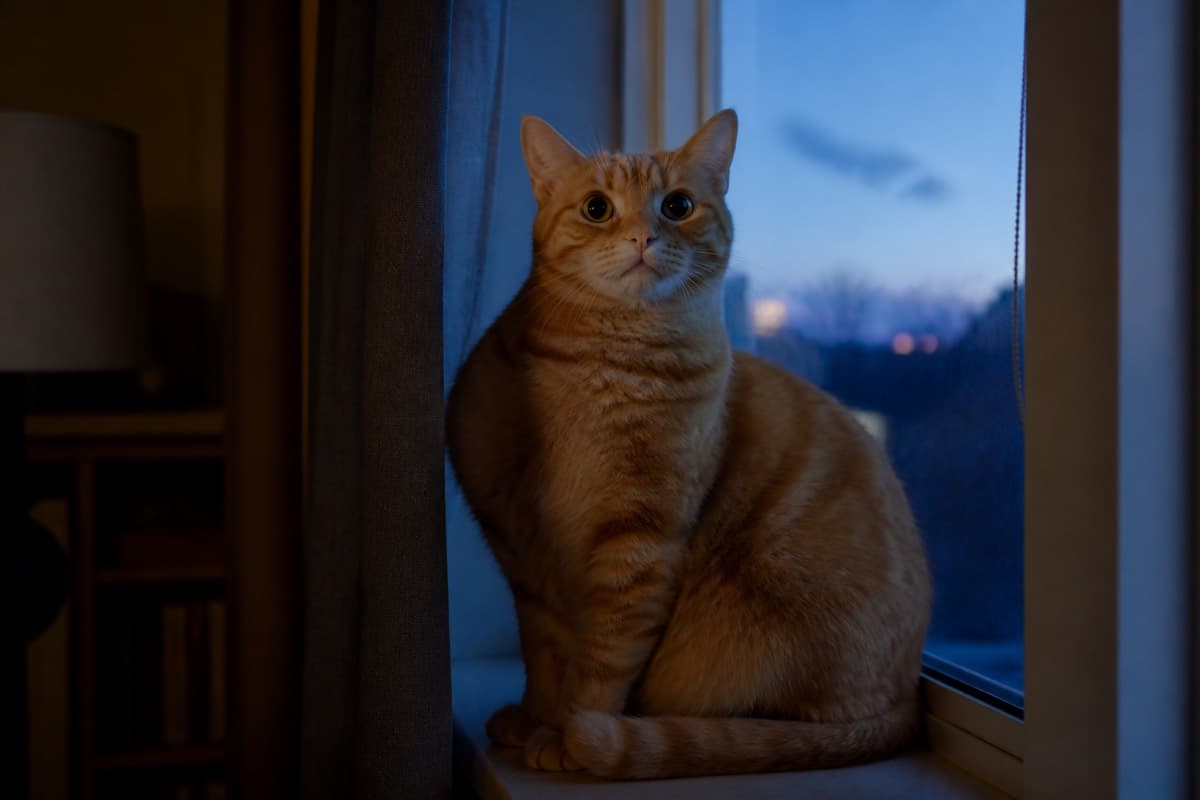
No. Cats cannot see in total darkness. They see much better than people in dim light, and PetMD is plain that they are not night-blind and also not equipped for complete darkness.
A sealed basement with zero light is still dark for a cat. A night light helps navigation. It is not infrared vision.
PetMD’s first takeaway is the featured-snippet answer: cats are not night-blind, and they also do not see in complete darkness. They see much better in low light than humans do. That is a twilight skill, not a blackout skill. In bright daylight, people detect motion better; cats are not built as noon specialists. In dim light (dusk, a night light, street glow), they have the advantage. In a sealed basement with no lamp, it is still dark for a cat.
House cats are crepuscular hunters. Dim-light eyes match dawn and dusk, when small prey moves and your hallway still has a little glow from a window or a clock. That is the pattern we walk through in are cats nocturnal. A 2 a.m. zoomie in a faintly lit flat is not proof they own true night.
On PetMD, Dr. Paul Miller estimates cats can see about 5.5 to 7 times better than humans in dim light (he repeats: not complete darkness). Dogs trail slightly behind cats on that night-vision comparison. The VIN / WALTHAM write-up says the same idea in threshold language: cats have a minimum light detection threshold up to 7 times less than humans. Those numbers are “how little light still works,” not “the lights can be off.”
PetMD describes the tapetum lucidum as a reflective membrane just behind the retina. When light misses the retina the first time, it bounces off the tapetum and gives the rods another pass. That improves vision in dim light. It does not perfect it. Glow in a photo or a headlight is that leftover reflection leaving the eye. People do not have a tapetum.
Miller’s WALTHAM notes on VIN add the hardware around it: a vertical slit pupil, a large cornea that lets more light in, and a retina dominated by rods. VIN also records that the feline tapetum reflects more light than the human fundus (their figure is up to 130 times). They also list a relatively posterior lens that makes a smaller, brighter image, and a form of rhodopsin that can keep gaining sensitivity for up to an hour. Dogs share many of those adaptations, to a less extreme degree.
VIN’s mechanism line is the same bounce you already heard: light comes back through the retina a second time. None of that hardware creates light. It spends the light that is already in the room. Eyes that glow are not a flashlight the cat aims at the hallway.
Cats have more rods than people and fewer cones. PetMD says color vision is limited mostly to blues and yellows. Two cone types make them dichromats. Miller’s line is that they have a hard time distinguishing red from green, so they are red-green color blind in that comparison. Motion still grabs them more than paint chips. If you want the dog color story next, are dogs color blind is the paired cone guide, not a night test.
Most cats are neither strongly nearsighted nor farsighted. Miller tells PetMD the vast majority are emmetropic, with some slightly far and some slightly near, and that older cats may need the feline version of reading glasses. They can focus clearly at about 10 inches or more; closer goes soft, which is why whiskers matter at nose range.
Published acuity numbers wander. PetMD reports many studies in a 20:100 to 20:200 band, and a later behavioral test nearer 20:30. Miller thinks 20:30 is closer to how cats stare at a bug on the ceiling. We will not pick a winner or invent a “seven times closer” rule from a page we are not citing. The owner point holds either way: dim-light hardware is a trade, not a free upgrade on every axis.
Owners hear a 2 a.m. yowl and invent night-goggles. The usual story is the crepuscular clock, plus whatever you have rewarded, which is why we keep sending that question to are cats nocturnal. A hall with streetlight under the door is usable. A closet with the door shut is not a cinema. A night light helps them move. Zero light is still zero light.
A new loud yowl, especially in a senior cat, is a veterinarian question. Pain and other medical changes show up when the house is quiet. This page cannot sort those. It can only retire the myth that yowling proves infrared sight.
If you also want the close-range sound story, why cats purr is the paired guide. This page is editorial. It is not a diagnosis. Read our about page for how we handle YMYL claims, then browse other Animals Details guides after you have set the hallway light.
No. PetMD: cats are not night-blind, and they also do not see in complete darkness. A basement with no window and no lamp is still dark for a cat. Dim light is their advantage. Zero light is zero light. A night light helps them move, not because they have infrared vision.
Dr. Paul Miller, speaking to PetMD, estimates cats about 5.5 to 7 times better than humans in dim light, not complete darkness. Dogs trail slightly behind cats. On VIN, Miller’s WALTHAM notes say a cat’s minimum light detection threshold can be up to 7 times less than a human’s.
The tapetum lucidum sits behind the retina. Light that missed the rods bounces back and gives those cells a second chance. PetMD says that is why eyes glow in a photo or a headlight. Glow is leftover reflection, not a flashlight the cat aims at the room.
PetMD: color is mostly blues and yellows. Cats have two cone types (dichromatic). Miller says they have a hard time telling red from green, so they are red-green color blind in that sense. Motion still grabs them more than hue. Dogs share the red-green limit.
PetMD: most cats are neither strongly near- nor farsighted. Miller says the vast majority are emmetropic, with some slightly far and some slightly near. They focus clearly at about 10 inches or more; closer goes soft. Whiskers help at nose range. Aging can add a “reading glasses” shift.
No. Yowling is a voice, not a vision test. House cats peak at dawn and dusk (crepuscular), which matches dim-light skill, not night-goggles. A hall with a little streetlight is usable. A sealed basement is not. New senior yowling is a veterinarian question, not proof of night vision.
A small light helps a cat navigate a house that is otherwise black. It does not give them infrared. PetMD is clear they do not see in complete darkness. You are lighting the room they already use well when a little light is there. Skip the night-goggle myth.
Reader notes are not veterinary advice. If an animal is unwell, call the veterinarian who sees them.
Be the first to leave a note on this guide.