Cats purr when they are content, and also when they are stressed or in pain. VCA, CFA, and what the 25-150 Hz healing idea actually claims.
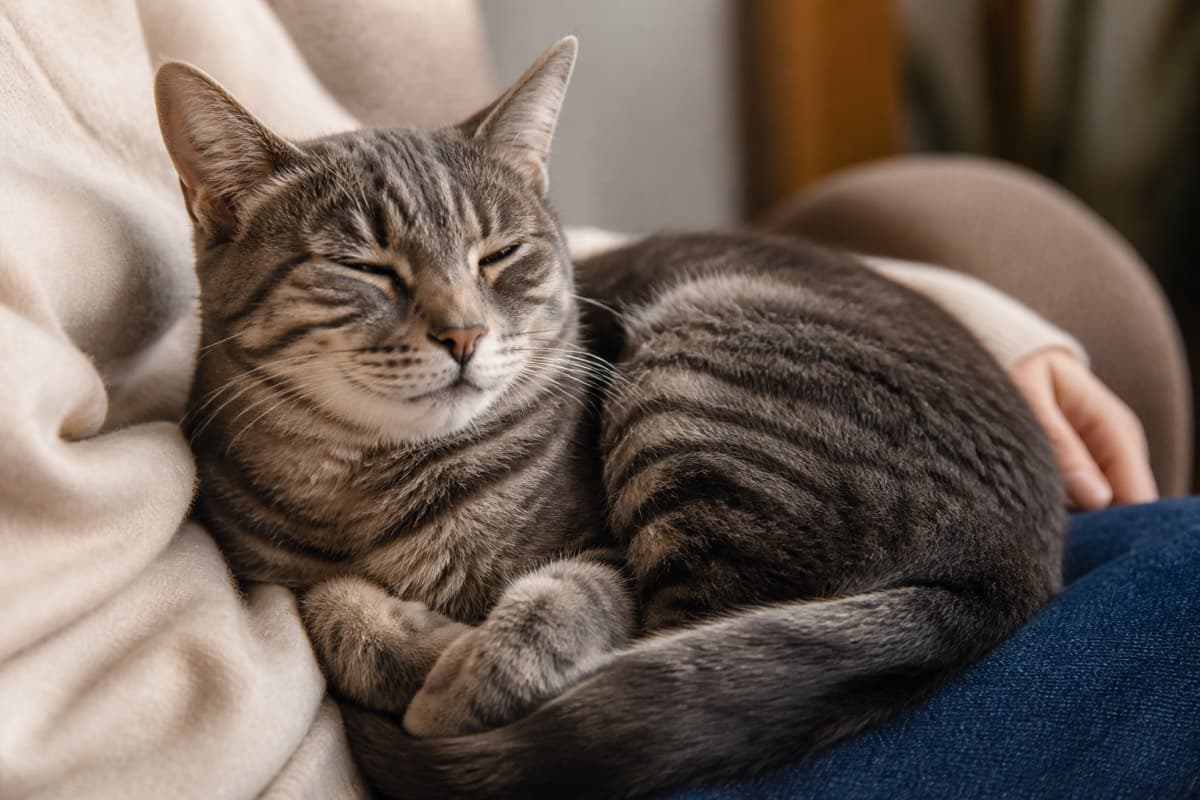
Purring is not only happiness. VCA says a purring cat is often content, but that is not always true, and extra purring plus a behavior change (hiding, not jumping, an energy shift) is a veterinary visit.
Purring can relate to pain. Cats hide illness. A lap purr with soft ears is one story. A hunched, hiding purr is another.
VCA’s true-or-false page is titled like a quiz for a reason. A purring cat is often a happy cat. That is not a rule. Extra purring plus a change in stairs, jumping, hiding, or energy is a reason to book the exam, not a reason to wait for a “sad meow.”
Their kitten-sound page says the same in owner language. Purring usually fits a calm, relaxed cat: in your lap, kneading (“air biscuits”). It can also signify stress or pain. Then you check the rest of the signal. Pinned ears, a hunched hide, or a skipped meal are not “still purring, so still fine.”
VCA also notes that purring can sit with other vocalizations (hissing, meowing, growling) when pain is in the mix. Pets are wired to hide illness. In the wild, weakness invited predators. The first job of the exam is to find the source of discomfort.
CFA says there is no one reason cats purr, and we do not know all of them. The obvious case is a relaxed, happy cat. Many mammals use low-frequency sounds in friendly, close company. Breeders know queens purr while nursing, and kittens purr while nursing. Because the sound is relatively quiet, CFA says it probably developed for short-range communication: queen to kitten, cat to cat. Scientific American makes the same nursing point, and adds petting, stroking, and feeding as the human version of that close contact.
Leslie A. Lyons, writing for Scientific American, says scientists have shown cats produce the purr through intermittent signaling of the laryngeal and diaphragmatic muscles. Cats purr on inhale and exhale, with a consistent pattern and frequency between 25 and 150 Hz.
CFA’s 2025 explainer agrees the sound forms on both the inhale and the exhale. They review older neuromuscular ideas and a 2023 Current Biology experiment (Herbst and colleagues) in which isolated larynxes produced a purr-like sound when air was pumped through. CFA is careful: that does not prove cats never use muscle input. It only shows muscle twitch is not always required in that setup.
CFA also notes a domestic cat’s bony hyoid can resonate those vibrations. We are not going to turn that anatomy note into a breed test. The owner fact is simpler: the purr is a low, close-range sound that rides both halves of the breath.
A night purr is not, by itself, a “nighttime happy” species clock. House cats peak at dawn and dusk. If you are sorting a 2 a.m. soundtrack, start with are cats nocturnal, then come back to the body-language check above.
Scientific American notes that investigators have studied sound frequencies in the 25-150 Hz range for bone density and healing in other settings. Lyons’s cautious line is communication plus a possible self-healing role, not a clinic protocol. Cats also purr at the veterinarian and while recovering from injury, which is why people reach for a “healing purr” story.
CFA is blunter on the human-bone claim. Other researchers have theorized that resting purrs could be a form of self-healing because the frequency overlaps vibration-therapy ranges used on human bone. CFA finds no scientific evidence that a cat’s purr heals human bones. Correlation is not causation. While they researched the topic, citations on healing properties of purrs pointed to one Journal of the Acoustical Society of America line (they name a 2006 cite). They did not find a stack of later clinic trials sitting behind the viral version.
We will not sell a purr as medical therapy. Do not skip pain care because the cat is still rumbling. Do not skip your own clinician because a sleep app has a purr track. The hypothesis is interesting. It is not a treatment plan.
VCA’s list is practical: reluctance to go up and down stairs or jump onto furniture, hiding, a change in energy, and more purring than your baseline. Book sooner rather than waiting for a “sad” vocalization. Cats hide illness. Finding the source of discomfort is the first step in a treatment plan with your veterinarian.
CFA adds what clinicians already hear: purrs during the exam (sometimes loud enough to hide a heartbeat), purrs when injured, purrs during euthanasia. They treat those as self-soothing under stress. Scientific American says the same in shorter form: not every purring cat looks content. A clinic purr is not a clean bill of health. Watch the rest of the body.
This page is editorial. It is not a diagnosis. Read our about page for how we handle YMYL claims. Browse other Animals Details guides after the appointment, not instead of it.
VCA’s true-or-false page answers false. A purr often rides with rest, a lap, or kneading. It can also ride with pain or stress. Read ears, posture, hiding, and appetite. Extra purring plus a behavior change is a veterinary visit, not a happy-cat assumption.
Scientific American (Leslie A. Lyons) says cats purr on inhale and exhale, 25-150 Hz, through intermittent signaling of laryngeal and diaphragmatic muscles. CFA reviews later larynx work and still treats the mechanism as discussed. The owner takeaway is the two-way breath and the low range, not a home experiment.
CFA says breeders know queens purr while nursing, and kittens purr then too. The sound is low in volume, so it fits short-range talk: queen to kitten, cat to cat. Scientific American also notes purring is most noticeable during nursing or when people pet, stroke, or feed.
CFA is direct: there is no scientific evidence that a cat’s purr heals human bones. They say healing-property citations point to one Journal of the Acoustical Society of America line (a 2006 cite). Frequencies in that band have been studied elsewhere. Hypothesis, not therapy.
Veterinarians hear purrs during exams, after injury, and even during euthanasia. CFA treats that as self-soothing. Scientific American notes cats often purr under duress, including clinic visits and recovery. A clinic purr is not a clean bill of health. Watch the rest of the body.
Not by itself. House cats are crepuscular: dawn and dusk, not a night-shift species. A quiet lap purr in the evening can still be rest. A new 2 a.m. soundtrack plus hiding or a skipped meal is the clinic question. Read our dawn-and-dusk guide for the clock.
VCA: if your cat is purring more than usual and that sits with other changes (will not jump or use stairs, hiding, an energy shift), schedule a veterinary visit. Cats hide illness. Purring can relate to pain, along with hissing, meowing, and growling. Finding the source is the clinic’s job.
Reader notes are not veterinary advice. If an animal is unwell, call the veterinarian who sees them.
Be the first to leave a note on this guide.