Onions, garlic, leeks, and chives can damage a dog’s red cells. Merck’s published examples, why signs lag days, and why this page has no leftover chart.
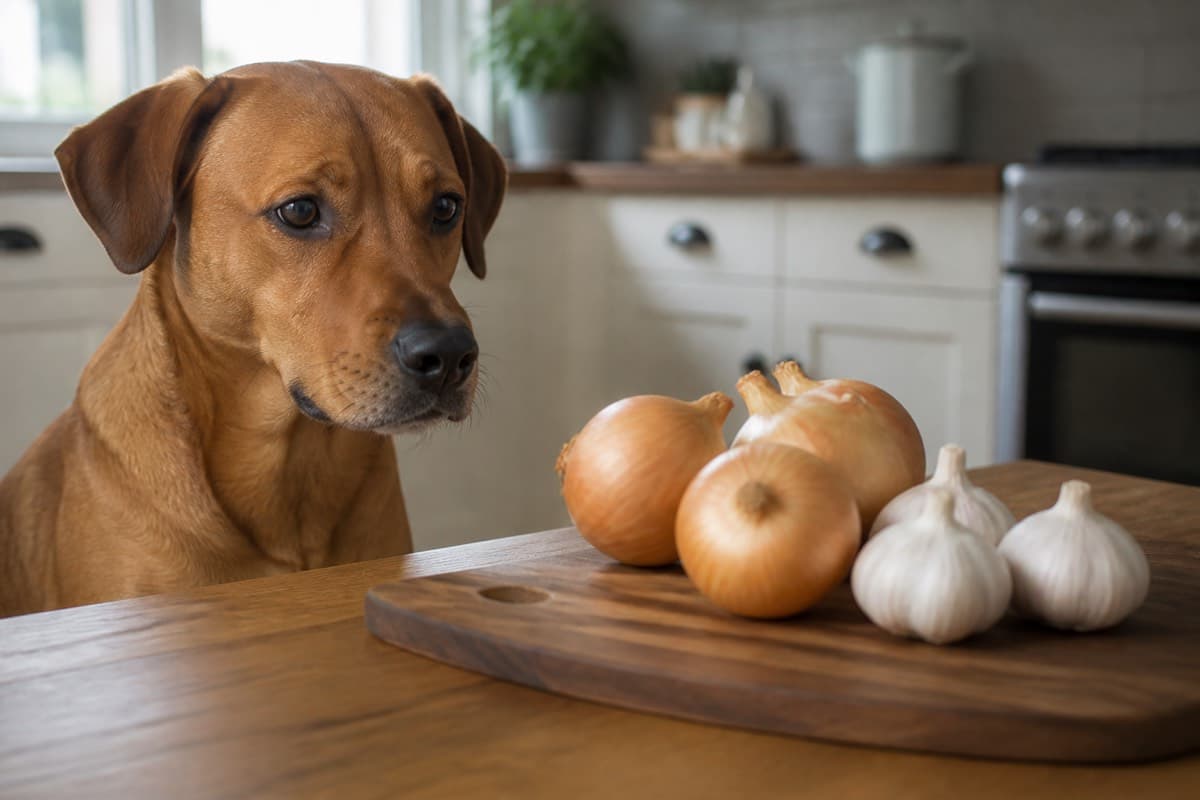
No. Dogs should not eat onions. If you searched can dogs eat onions, garlic, leeks, and chives are the same Allium problem. Merck says raw, cooked, dehydrated, and granulated forms all count.
Write the form, a weight estimate of what is missing, the time, and your dog’s weight, then call. We do not publish a leftover-onion permission chart.
Merck describes Allium toxicosis after dogs or cats ingest onion or garlic. The plants contain sulfur-containing oxidants. Chewing, cooking, and chopping release them. Those oxidants damage red blood cells.
Merck lists Heinz body hemolytic anemia and methemoglobinemia. The oxidative injury begins within 24 hours and peaks around 72 hours. Hemolysis typically occurs 3-5 days after exposure. Signs of anemia can lag several days: weakness, pallor, icterus (yellow gums or skin), and collapse. A dog that still looks fine after supper is not a cleared dog.
There is no specific antidote. Merck says treatment is early GI decontamination plus management of the anemia, chosen by a veterinarian. That list is what they may do. It is not a home kit.
Garlic, leeks, and chives sit in the same Allium family as onions. This page covers that family. Garlic is often worse per gram because it is more concentrated. We still do not publish a homemade garlic-dose chart. Powder is more concentrated than a slice.
Merck says cats are the most susceptible species, then dogs. Concentrated forms (flakes, powder, dry onion soup mix) are the usual crisis. Merck also publishes these examples, which are clinic risk lines, not leftover permission:
| What Merck publishes | How to read it |
|---|---|
| Dogs: 15-30 g/kg raw onion has resulted in clinical toxicosis | A published example, not a leftover snack you “get away with” |
| Cats: toxicosis after less than a teaspoon of cooked onions, or 5 g/kg raw onions | Cats are most susceptible. Cooked still counts |
| Flakes, powder, dry onion soup mix | Usual crisis. More concentrated than a slice |
The dvm360 Allium brief and the ASPCA / Veterinary Medicine review make the same owner point: cooked, raw, and powder all count. After a recent ingestion, the breath may smell of onion or garlic.
Remove what is left. Do not chase the dog around the house for the last piece. Write the form (raw, cooked, powder, or soup mix), a weight estimate of what is missing, the time, and your dog’s weight. Then call an emergency veterinarian. You can also call ASPCA Animal Poison Control at 888-426-4435 or Pet Poison Helpline at 855-764-7661 (fees may apply).
Say if chocolate, raisins, or another toxin was in the same bowl. One call should cover the whole list. Do not invent hydrogen peroxide, salt, or syrup of ipecac from a comment thread. Decontamination belongs to the clinic that can also watch the red cells over the next several days.
“It was cooked in the stew” does not clear the case. Merck says raw, cooked, dehydrated, and granulated all count. Waiting for pale gums wastes the early window. Form, species, and concentration change the math. Merck’s gram examples are clinic risk lines, not a snack you portion at the counter.
Merck’s timeline is the reason “he seems fine tonight” is a weak plan. Oxidative damage begins within 24 hours and peaks around 72 hours. Hemolysis typically occurs 3-5 days after exposure.
Signs of anemia can lag several days: weakness, pallor, icterus, collapse. Breath that smells of onion or garlic can be an early clue after a recent ingestion, per the dvm360 brief. It is not proof that the red cells are finished with the case. Absence of signs is not clearance. Call with the form, amount, time, and your dog’s weight even if the dog still looks fine.
Keep onions, garlic, soup mix, and seasoned leftovers out of reach. If you want another food-safety guide after the clinic has the case, start at the Animals Details blog. This page is editorial. It is not a diagnosis.
No. Merck says raw, cooked, dehydrated, and granulated onions and garlic all count. Cooking does not make Allium safe. Write whether it was raw, cooked, powder, or soup mix, plus amount, time, and dog weight, then call. Leftover stew is still a phone-call problem, not a homemade snack.
Garlic is often worse per gram because it is more concentrated. This page covers the whole Allium family: onion, garlic, leeks, and chives. We do not publish a homemade garlic-dose chart. Merck’s published examples are clinic risk lines, not leftover permission. Call with the form, amount, time, and dog weight.
Merck says concentrated forms (flakes, powder, dry onion soup mix) are the usual crisis. Powder is more concentrated than a slice. Cats are most susceptible, then dogs. Write that it was powder or soup mix, not “just seasoning.” Call a veterinarian or a poison hotline with amount, time, and weight.
No. Merck says the oxidative injury begins within 24 hours and peaks around 72 hours. Hemolysis typically comes 3-5 days after exposure. Signs of anemia (weakness, pallor, icterus, collapse) can lag several days. Waiting for pale gums wastes the early decontamination window. Call now, even if the dog still looks fine.
Not from this page. Merck says there is no specific antidote. Treatment is early GI decontamination plus managing the anemia, decided by a veterinarian. We do not invent home peroxide, salt, or ipecac. Write form, amount, time, and dog weight, then call an emergency clinic or a poison hotline.
Yes. Dogs should not eat onions. Garlic, leeks, and chives are the same Allium problem. Raw, cooked, and powder all count. This page covers the family, including garlic. We do not publish a separate leftover chart for each plant. Call with what was eaten, how much, when, and the dog’s weight.
Call an emergency veterinarian first if you have one nearby. You can also call ASPCA Animal Poison Control at 888-426-4435 or Pet Poison Helpline at 855-764-7661. Fees may apply. Have form (raw, cooked, powder, or soup mix), amount, time, and dog weight ready before you dial.
Reader notes are not veterinary advice. If an animal is unwell, call the veterinarian who sees them.
Be the first to leave a note on this guide.